
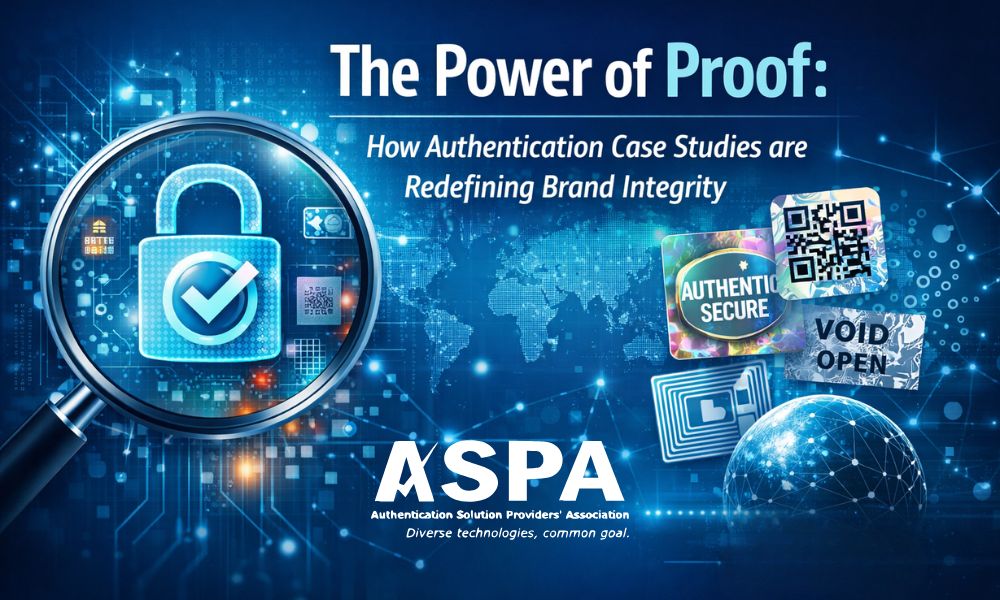
In an era where digital and physical markets are flooded with sophisticated replicas, Authentication Case Studies have become the ultimate blueprint for brands seeking to reclaim their market share. These real-world examples do more than just showcase technology; they provide a roadmap for businesses to navigate the treacherous waters of global counterfeiting. Organizations like ASPA (Authentication Solution Providers’ Association) Global are at the forefront of this movement, fostering an ecosystem where advanced technologies meet ethical standards to protect both revenue and reputation.
How Did Advanced Authentication Help Brands Stop Counterfeiting in Real-World Cases?
Counterfeiting is no longer a backyard operation; it is a multi-billion dollar illicit industry. Advanced authentication provides the “digital lock” that counterfeiters cannot pick. Real-world cases show a shift from simple stickers to multi-layered security.
1. Luxury Goods: Beyond the Hologram
A high-end fashion house recently integrated unclonable NFC (Near Field Communication) tags into the lining of their handbags.
- The Problem: Traditional holograms were being scanned and printed by counterfeiters within weeks of a product launch.
- The Solution: Encrypted NFC tags that link to a unique digital twin on a private server.
- The Outcome: The brand saw a 35% reduction in grey market diversions and used the scan data to identify specific regions where fake products were most active.
2. The FMCG Sector: Smart Packaging
Fast-Moving Consumer Goods (FMCG) brands often suffer from “refill fraud.”
- The Case: A premium spirits brand introduced tamper-evident QR codes that break upon opening.
- Verification: Customers scan the code to verify the bottle’s journey. If the code was previously scanned, the system alerts the user that the product might be a refill.
- Impact: This simple digital-physical hybrid restored consumer trust and boosted loyalty program participation by 20%.
How Are Pharma Brands Using Authentication Case Studies to Protect Patients?
In the pharmaceutical industry, the stakes are higher than lost revenue; it is a matter of life and death. Authentication Case Studies in this sector highlight how rigorous tracking saves lives.
- Invisible Cryptographic Signatures: One multinational pharma giant faced an 84% counterfeit rate in unregulated online pharmacies. By embedding invisible digital signatures into their packaging artwork, they allowed patients to verify medication using a standard smartphone.
- Outcome: Over 186,000 patients were protected from substandard medicine in just one year of implementation.
- Mass Serialization: By assigning a unique, randomized serial number to every single blister pack (not just the carton), brands can track a product from the factory floor to the patient’s hand.
The ASPA Connection: As a global self-regulated body, ASPA Global emphasizes that “authentication is not a product, but a process.” They advocate for the “Authentication Ecosystem,” which combines physical security features with digital tracking to ensure that the patient receives exactly what the doctor prescribed.
How Are AI and Blockchain Changing Authentication Case Study Outcomes?
The “Golden Age” of brand protection is being driven by the convergence of Artificial Intelligence (AI) and Blockchain. These technologies turn passive labels into active, intelligent security measures.
The Role of AI in Detection
AI is the “eye” that never sleeps. Modern case studies show AI-powered image recognition being used to:
- Identify microscopic differences in printing patterns that the human eye misses.
- Analyze “Digital Fingerprints” of packaging textures.
- Monitor online marketplaces to automatically flag and take down counterfeit listings.
The Blockchain as an Immutable Ledger
Blockchain provides the “Source of Truth.” When a product is authenticated via a case study involving blockchain, the outcome is usually:
- Zero Data Manipulation: Once a product’s “birth certificate” is on the blockchain, it cannot be altered by a corrupt distributor.
- End-to-End Transparency: Every hand that touches the product—from the raw material supplier to the retailer—is recorded.
Key Benefits of Implementing Advanced Authentication
Based on various Authentication Case Studies, the benefits of adopting these technologies include:
- Revenue Recovery: Direct reduction in sales lost to counterfeiters.
- Legal Protection: Providing a clear “Chain of Custody” in case of litigation or regulatory audits.
- Consumer Engagement: Turning a security scan into a marketing opportunity (loyalty points, product info).
- Regulatory Compliance: Meeting global standards like the DSCSA (Drug Supply Chain Security Act).
- Sustainability: Reducing the need for bulky physical security labels by using invisible digital markers.
The Role of ASPA Global in Shaping the Future
The Authentication Solution Providers’ Association (ASPA) Global plays a pivotal role in this industry. Originally focused on holography, ASPA has evolved into a global voice for the entire authentication industry.
Why ASPA Matters:
- Standardization: They help set the “Hologram Safety and Security Management Standards” (HSSMS), ensuring quality across the board.
- Advocacy: ASPA works with governments to integrate anti-counterfeiting measures into national policies.
- Awareness: Through their “The Authentication Forum,” they bridge the gap between technology providers and brand owners.
- Ethics: They ensure that authentication solutions respect consumer privacy while providing maximum security.
Summary of Authentication Technology Outcomes
| Technology | Industry Primary Use | Key Outcome |
| NFC/RFID Tags | Luxury & Electronics | Real-time tracking and unclonable identity. |
| Invisible Ink/DNA | High-Value Pharma | Forensic proof that holds up in court. |
| Blockchain | Global Supply Chains | An immutable record of every transaction. |
| AI Vision | E-commerce | Instant detection of fakes in photos. |
| Holograms (Advanced) | Documents & FMCG | Immediate “overt” verification for consumers. |
Conclusion
The evidence from recent Authentication Case Studies is clear: brands that invest in multi-layered security are the ones that survive the counterfeit crisis. Whether it is a luxury brand using AI to scan for fakes or a pharmaceutical company using blockchain to save lives, the goal is the same—Trust.By partnering with organizations like ASPA Global, brands can ensure they are using the most advanced, ethical, and effective tools available. In a world of fakes, being authentic is your greatest competitive advantage.
 Authentication Case Studies | ASAP Global